Patient Education
What Is Continuous Glucose Monitoring?
By Miracle Olajuyigbe 7 min read
The problem with four dots on a graph
If you live with diabetes and check your blood sugar four times a day, you are working with four numbers. A continuous glucose monitor produces around 288 in the same 24 hours.
That gap is the whole story.
Finger-stick testing is not a bad tool. It is accurate, cheap compared to the alternatives, and for plenty of people entirely adequate. But it tells you where your glucose is at the second you pricked your finger, and nothing about where it came from or where it is going. A reading of 130 mg/dL looks reassuring. It looks very different if twenty minutes ago it was 210 and falling fast.
The blind spots are predictable, and they are the ones that cause harm. Overnight lows you sleep through. The rise that starts two hours after a meal, well after you stopped checking. The slow drift across a week that shows up months later as a worse A1c with no obvious explanation. I have sat with patients who tested exactly when they were told to and still could not account for their numbers. The missing information was usually in the hours nobody was measuring.
What a CGM actually is
A continuous glucose monitor is a small sensor that sits under your skin and takes a glucose reading every few minutes, day and night.
Physically, there are three parts, though on newer devices two of them are fused into one disposable unit.
The sensor is a thin, flexible filament, roughly the thickness of a few strands of hair, inserted just under the skin of the upper arm or abdomen with a spring-loaded applicator. Insertion takes a second or two, and most people describe it as a snap rather than a needle. The transmitter sits on the skin above it and sends readings wirelessly. The receiver is whatever displays them, which for most people now means a phone.
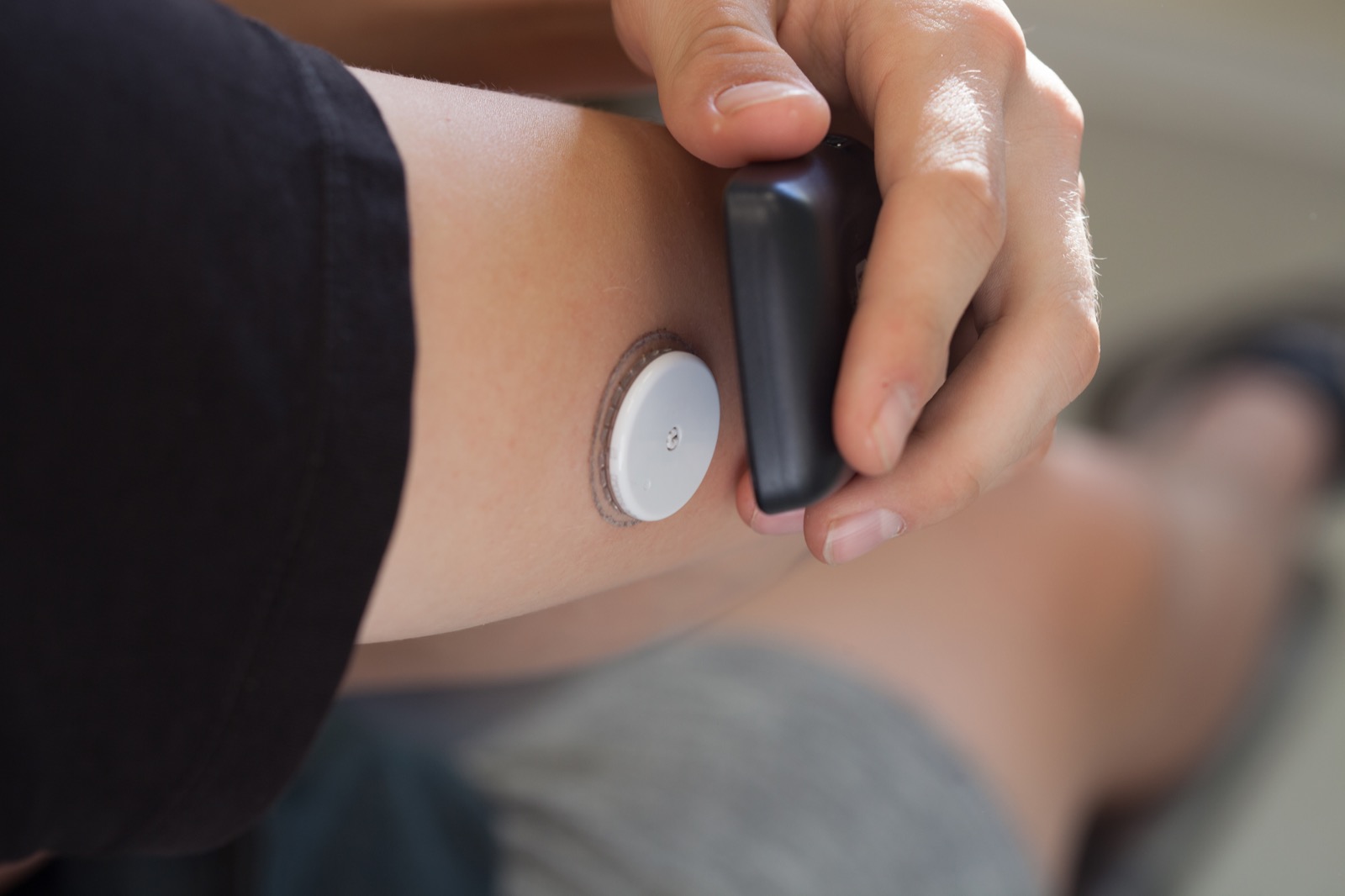
Here is the part most explainers skip. A CGM does not measure glucose in your blood. It measures glucose in interstitial fluid, the fluid between your cells, and glucose takes five to ten minutes to move there. When your level is stable that difference is trivial. When it is moving fast it is not. If you are treating a low and the sensor still reads 62, the number describes where you were, not where you are. That is why manufacturers still tell you to confirm with a finger stick when your symptoms and the sensor disagree, and why the instruction is not corporate throat-clearing.
The other thing a CGM gives you is direction. A number with an arrow beside it is a different piece of information from a number alone, and most of the day-to-day value patients describe comes from seeing what is about to happen.
Who benefits most
The evidence is strongest, and least ambiguous, in a few specific groups.
People with type 1 diabetes, and people with type 2 diabetes who use insulin. Anyone dosing insulin several times a day is making frequent decisions with real downside risk in both directions, and CGM data improves those decisions.
Anyone with hypoglycemia unawareness. If you have lost the adrenergic warning signs, the shakiness, the sweating, the racing heart, then a device that can alarm at 3 a.m. is not a convenience. It is a safety net. In my view this is the single strongest indication for CGM, stronger than the A1c argument, and it is underweighted in most coverage decisions.
Pregnancy with type 1 diabetes, where targets are tighter and the consequences of missing them accrue to two patients. And anyone starting or adjusting a new regimen, since two weeks of continuous data can answer questions that six months of finger sticks would not.
A growing group of people without diabetes now wear CGMs out of metabolic curiosity. I will not tell anyone what to do with their own money, but the outcome evidence there is thin, glucose in a non-diabetic body fluctuates in ways that look alarming and mean nothing, and the likeliest harm is anxiety and unnecessary food restriction.
Who a CGM is not automatically right for
This is the section that gets left out of most articles about CGMs, usually because the article is downstream of someone selling them.
Cost is a real barrier, and for most of the world it is the barrier. In the United States, sensors run in the range of a hundred dollars or so each, with most needing replacement every ten to fifteen days. With insurance, the picture varies enormously by plan and by whether you meet the coverage criteria, which have loosened over the past few years but still exclude plenty of people who would benefit. Without insurance, it is a recurring expense that competes with rent.
Outside high-income countries the arithmetic is worse. In much of sub-Saharan Africa there is no meaningful insurance mechanism for this at all. Care is paid out of pocket, and I have looked after patients who were rationing test strips, which cost a fraction of what a sensor costs. Telling that patient about time-in-range optimization is not clinical guidance. It is a description of a country they do not live in.
The device assumes a smartphone and reliable power. That assumes you own a compatible phone, that it stays charged, that you are not sharing it with three other people, and that you have data. Notice too that older patients are the ones most likely to have hypoglycemia unawareness and least likely to be comfortable with the app layer.
Data without interpretation is not care. This is the failure I have seen most often, and it is the one the industry has the least incentive to name. A CGM generates an enormous amount of information. Turning that information into a changed insulin dose, a changed meal, a changed basal rate, requires someone who knows how to read an ambulatory glucose profile and has the time to sit with you and do it. Where a follow-up appointment is eleven minutes long and happens twice a year, that review often does not happen. What the patient gets instead is a stream of numbers and alarms, an accurate sense that something is wrong, and no plan. Some respond by stacking insulin doses because the graph is going the wrong way, causing the exact lows they were trying to avoid. Others quietly silence the alerts. I have watched patients do both.
A CGM is a diagnostic tool, and tools do not treat people. If your health system cannot fund the clinician time to interpret the output, the sensor solves less than the brochure suggests.
What the evidence actually shows
The research base here is unusually good, which is worth saying because it is not true of every device in digital health.
In the DIAMOND trial, published in JAMA in 2017, adults with type 1 diabetes on multiple daily injections lowered their A1c by about 1.0 percentage point over 24 weeks with CGM, against roughly 0.4 points with finger sticks alone.
The MOBILE trial in 2021 looked at a group this research had mostly ignored: adults with type 2 diabetes on basal insulin in primary care. A1c fell from about 9.1 to 8.0 percent with CGM, against 9.0 to 8.4 percent with standard monitoring. A smaller gap, in a far larger population.
The CONCEPTT trial in The Lancet found improvements in neonatal outcomes among pregnant women with type 1 diabetes, including fewer large-for-gestational-age infants and fewer NICU admissions lasting more than 24 hours. That trial changed practice.
The field has also adopted time in range, the share of the day spent between 70 and 180 mg/dL. Consensus targets for most non-pregnant adults sit above 70 percent in range, under 4 percent below 70 mg/dL, and under 1 percent below 54. It carries information A1c cannot: two people can share an A1c of 7.5 percent, one steady, the other swinging between 50 and 300. Those are not the same clinical situation, and until recently we had no routine way to tell them apart.
Frequently asked questions
Does a CGM hurt? Insertion is brief and most people find it easier than expected. It is not comparable to a blood draw. Some people get skin irritation from the adhesive, which is usually manageable with barrier films or by rotating sites.
Do I still need to prick my finger? Less often, and with some systems not at all for routine dosing. Still confirm when the reading does not match how you feel, when treating a low, and in the first hours after a new sensor.
How accurate are they? Current sensors report a mean absolute relative difference of roughly 8 to 10 percent against laboratory values, which is good enough for most treatment decisions. Accuracy is worst at the extremes and during rapid change, which is exactly when you care most, so keep the confirmation habit.
Can I use one if I have type 2 diabetes and do not take insulin? You can, and a two-week wear is often useful for seeing how particular meals affect you. Whether it justifies ongoing cost is a separate question, and coverage in this group is inconsistent.
Will my doctor see the data? Only if you share it, and only if your clinic uses the platform. Sharing is usually opt-in through the app. Ask at your next visit whether they can actually view your reports, because a surprising number of clinics cannot.
Where this goes next
The technology is improving in the directions you would want: longer wear, smaller sensors, better accuracy, tighter integration with insulin pumps so the system adjusts delivery on its own. Automated insulin delivery built on CGM data is already standard care for many people with type 1 diabetes in countries that can pay for it, and it works.
The harder problem is not engineering. Sensors will keep improving whether or not anyone solves distribution. For CGM to reach most people with diabetes worldwide, the price has to fall far enough to compete with test strips rather than with rent, coverage has to follow clinical need rather than diagnosis codes, and health systems have to fund the clinician time to read the data with the patient. Prices are falling, slowly. Coverage is moving in some places and not at all in others. The clinician time is barely being discussed, which tells you something about who is setting the agenda.
This article is general health information and is not a substitute for individual medical advice. Discuss monitoring options with your own clinician.